

A High Schooler's Guide to the French National Centre for Scientific Research
Issue date:2026-04-24
Since 1962, UWC has grown into a global network of over 85,000 alumni. How can a UWC CSC student turn that network into real impact?
In 2025, Karen (CSC Class of 2025), inspired by the Nobel Innovation Workshop, founded the UWC Science Collective to expand access to STEM opportunities. The Collective launched the first UWC Science Conference and Mentorship Program, bringing together 27 alumni from fields such as quantum physics and materials science, along with 14 student and alumni moderators. The livestream reached over 10,000 viewers.
More than a conversation, the Conference led to real outcomes: three UWC CSC students secured internships at the French National Centre for Scientific Research. In this article, DP1 student Siqi (Sage) Li shares her internship experience in Paris, alongside fellow DP1 Akararath (Pac) Chokthitirath and FP Songran (Kara) Wang.
▲ Internship vlog by Sage and Kara
"If anyone knew how to make
things better, it would be you."
My first experience with the Science Collective started by chance. I was walking to my favorite study room after a long, exhausting day when a voice from behind asked, "Are you Sage?"
"I'm Karen Tao. Would you like to join the UWC Science Collective?"
Karen was then a DP2 student. She had founded the UWC Science Collective a few months earlier, whose mission was to leverage the untapped potential of the UWC network to promote STEM within UWC and to create a ripple effect in the wider world.
Karen was inspired by our school's new Nobel Innovation Workshop, in which she attended lessons in neuroscience delivered by a Nobel laureate: how could more people benefit from opportunities like this?
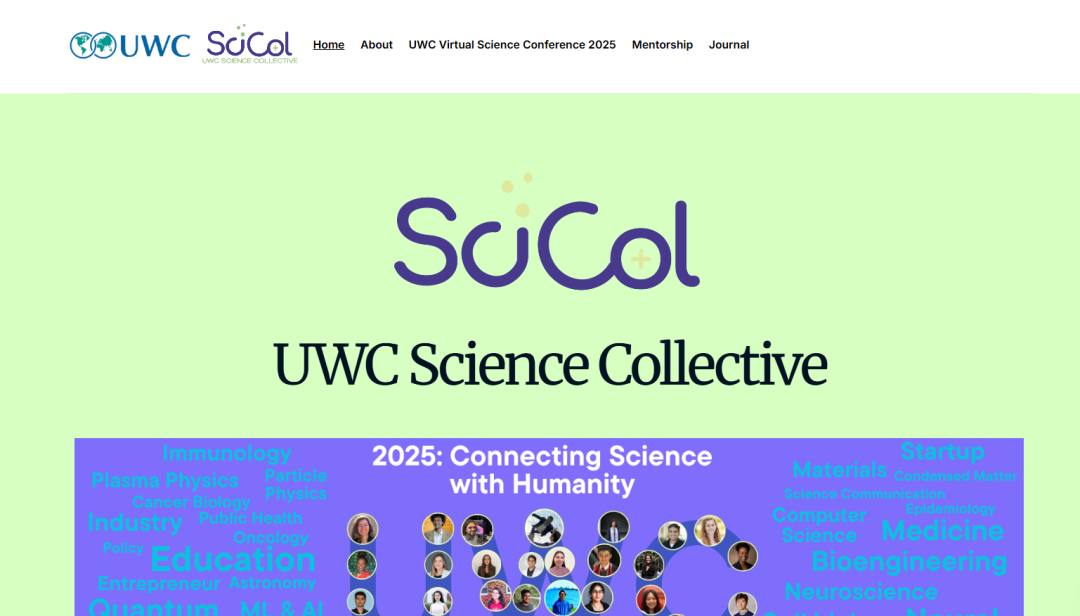
▲ UWC Science Collective Website
I had never met Karen before. Months later, when I asked her why she had approached me out of the blue, why me specifically, she said, " I overheard you in the canteen talking about how to improve the FP curriculum. I thought that if anyone knew how to make things better, it would be you."
Karen was right. I felt that there was room for improvement in the lives of STEM students at CSC. She inspired me to put thoughts into action, and together with some other students, we devised the first-ever UWC Science Conference.
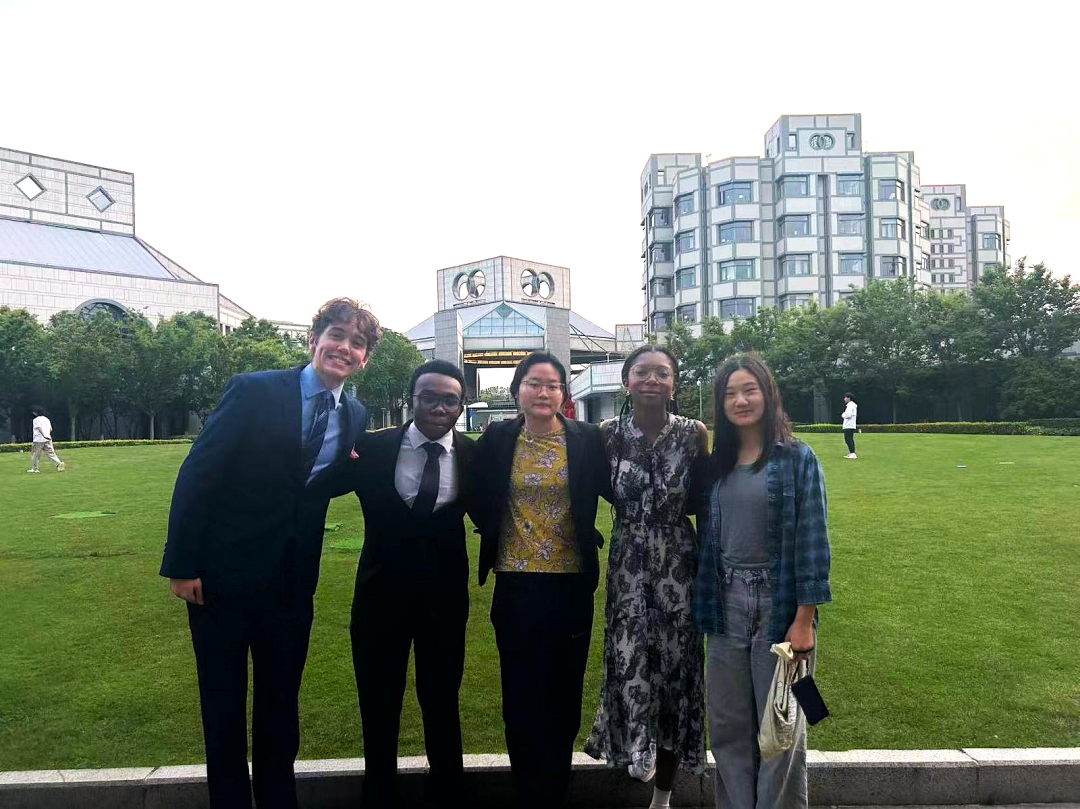
▲ Core members of the UWC Science Collective
The conference took place in late June 2025. We invited 27 UWC alumni from around the world, working in various scientific fields, to speak about their life stories and research.
I told myself it was just an ordinary YouTube livestream, until one day I met a student who had watched our conference. He spoke enthusiastically about how much he had learned by listening to the speakers and working with them in a Mentorship Program, also organized by the Science Collective.
I realized that perhaps we had done something more valuable than just a livestream. Maybe we had succeeded in bringing together an undiscovered network of people who inspire the next generation of STEM leaders. Somewhere out there, there might be a child whose dreams and ambitions were shaped by what they saw in our livestream.
It is this thought that inspires me to move forward.
United, We Can
Our conference attracted more than just students. Ulf Gennser, an Atlantic College alumnus from the class of 1978, now works at a research centre in France. He joined us on mic for a lively discussion. Sadly, I was not there.
Afterwards, Faisal and I, the only French speakers in the Collective, were tasked with following up with him by email.
Ulf replied very quickly. He agreed to meet with us over Zoom and listed several ways he could help, from introducing contacts in biology, astronomy, and mathematics to supporting physics teaching at UWC and offering practical training projects in his lab.
I was once again astonished by the unity of the UWC network. I would never have imagined that an alumnus would offer so much to students he had only met once.
Our first virtual meeting confirmed that we were going to have an internship. However, the project was put on hold as members of the Collective scattered for their summer plans.
By the time things had settled enough for me to pick up where we left off, Karen had gone to college, and the rest of the team had become deeply occupied with DP2 academics.
Did I think about giving up? No way.
I met with Ulf a couple more times on my own and drafted a plan for the internship. We decided on a two-week training session at the Centre for Nanosciences and Nanotechnologies of the French National Centre for Scientific Research in Paris, where Ulf works.
I estimated the cost and found that it would be about 2500 euros in total, including airfare from China. I was pleased to see this, since many other "internship" programs operated by certain companies cost much more. We were doing something significantly more meaningful and significantly less expensive.
Even though 2500 euros is relatively affordable, it is still a notable sum for many people, and I did not want my project to become exclusive. I explored every possible way to secure funding, but none worked out.
In the end, I had to limit the program to students who could afford the cost. This is my greatest regret throughout the project, and I hope to address it next year.
Speaking of interns, who should I take with me to Paris? I had no idea how to select them, so I sought help from the head of the science department at CSC, Kelvin Ofosu. Together, we designed a two-part selection process: a written application followed by an interview.
The application was released as a Microsoft Form with questions designed to assess applicants' prior experience and motivation. I decided to prioritize passion and motivation, alongside basic knowledge, since I hoped to continue this internship program next year. I needed interns who would impress researchers with their curiosity and enthusiasm.
I waited anxiously for responses. The first one came three days later. I opened it immediately, excited to see what the applicant had written. However, the answer was barely more than a single sentence, filled with typos.
I was stunned. I had thought people would take this valuable and rare opportunity more seriously.
By the deadline, I had received 13 responses. To my relief, many applicants had clearly put thought into their answers. Hope was not lost.
I now faced another dilemma: choosing the three students who would go to Paris with me. After a series of formal and informal interviews, the question resolved itself, heartbreakingly: only three qualified applicants could afford the cost. Once again, I was reminded how important it is to secure financial aid for next year.
Of the three selected, one dropped out because her parents refused to let her go.
Visas became an unexpectedly frightening process. After our first application was rejected, we reapplied and succeeded on the second attempt, largely thanks to one intern’s mother, who agreed to travel with us to France.
After a long and difficult process, I finally boarded my flight to Paris.
A Passion for Science
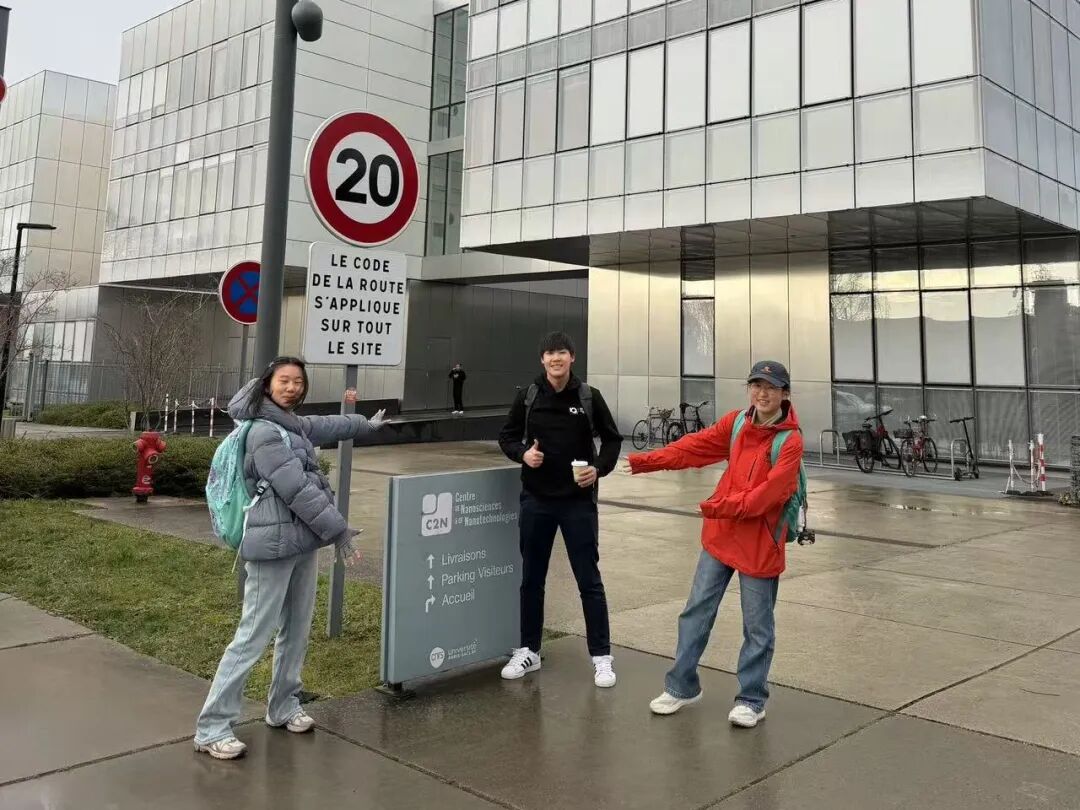
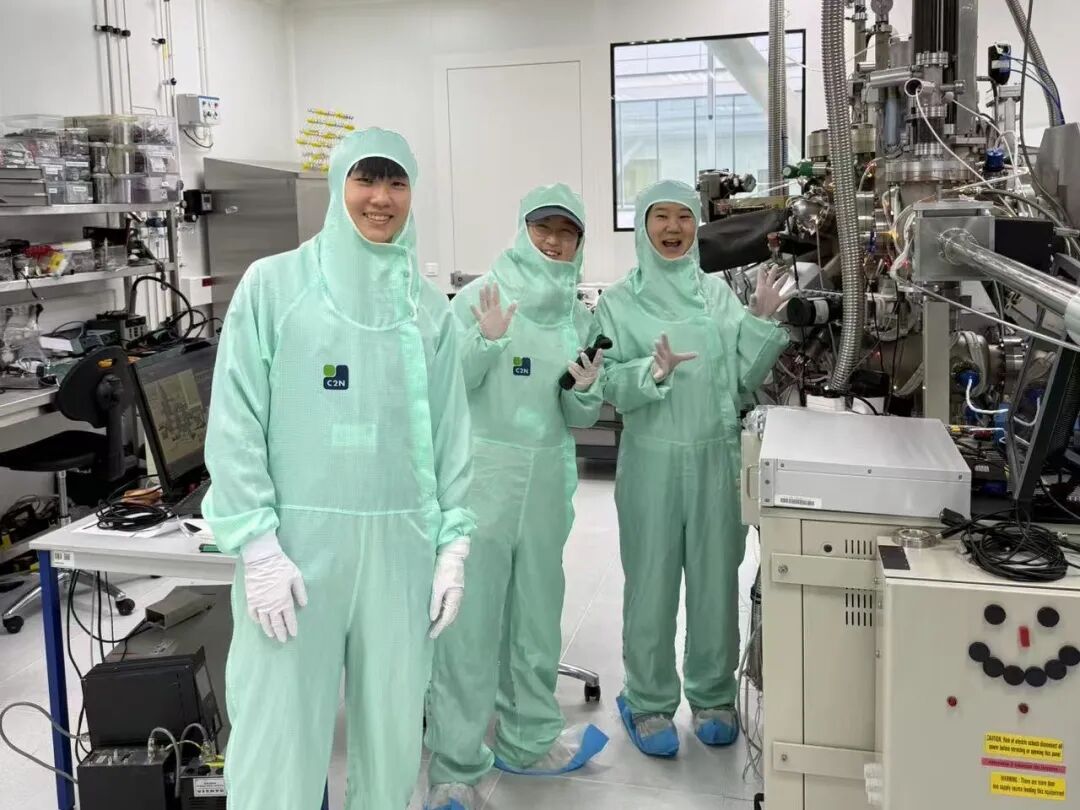
We were received by Ulf on our first day at the lab. My first impression was that he looked like Santa Claus without the red outfit and white beard, and he was just as kind and warm. He introduced us to the lab and gave us a tour of the cleanroom, where delicate equipment is kept under controlled conditions to minimize contamination from dust.
Ulf arranged for each of us to shadow different researchers each day according to our interests. I spent one day in the cleanroom watching a PhD student etch nanometer-scale patterns, another day attending a spontaneous three-hour lecture on 2D heterostructures, and yet another day working on photonic experiments.
I could not imagine being happier in Paris during those two weeks.
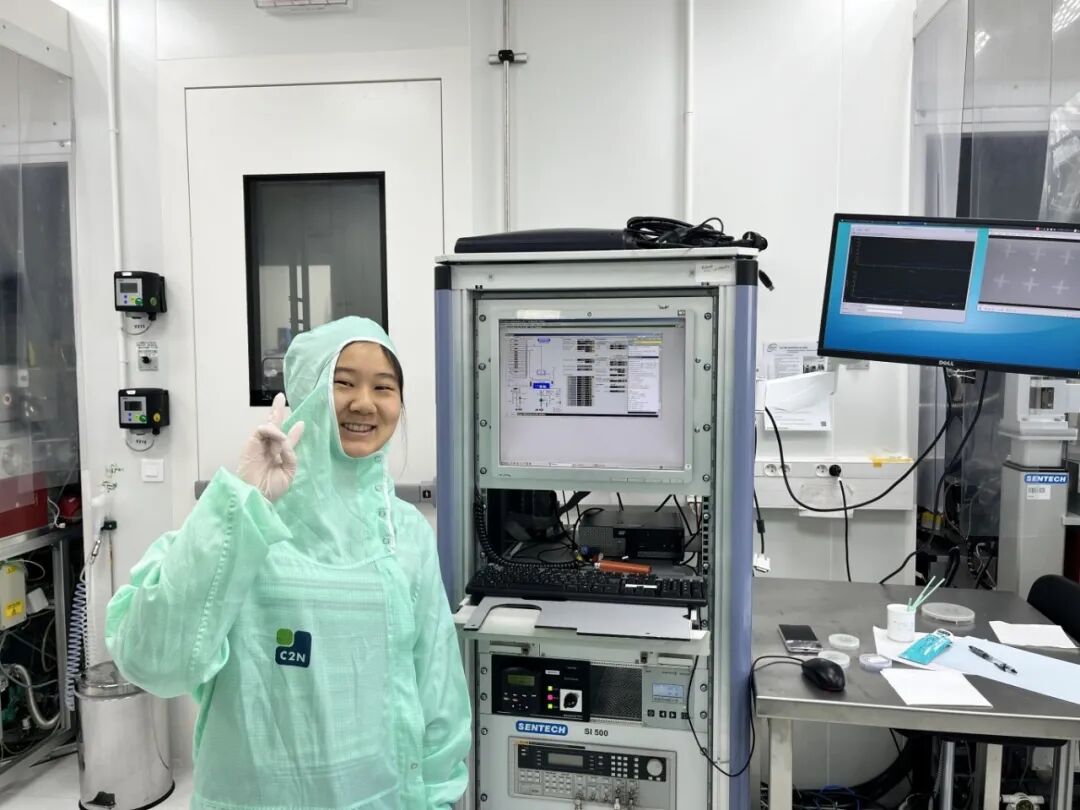
I learned more than I could fully absorb. I became fascinated by quantum computing and hope to pursue it further. I also saw physics applied in remarkably ingenious ways, including analog light-speed computing with photons, submillimetre wavelength devices, and quantum cryptography. At the same time, I was struck by the simplicity of some methods, such as making graphene with adhesive tape and mixing solutions by hand.
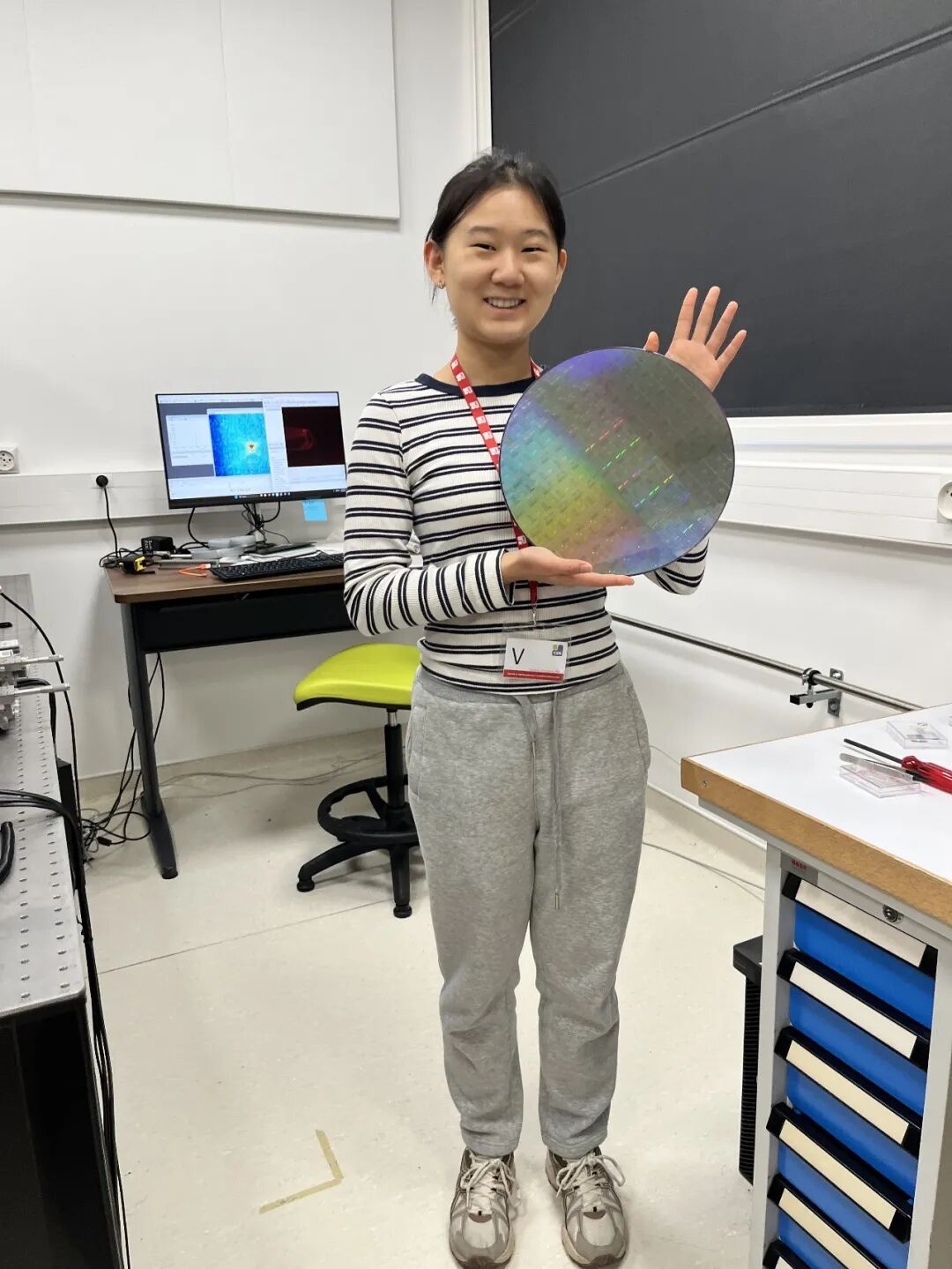
▲ This is my first time seeing an entire silicon wafer. As the basis of most experiments at the lab, it will be cut into smaller pieces to hold all sorts of circuits and crystals. I think it's very beautiful, with a multicolored sheen amid the grey. Science has more than just complex formulas and experiments; it also holds great beauty, and it is this beauty that motivates scientists to discover even more secrets of nature.
However, knowledge can be forgotten. What impacted me most was the researchers' passion. I was surprised that no one was scrolling on their phones or browsing casually on their computers. This was striking to me, coming from an environment where people are often glued to social media. Their love of science was tangible.
Technically, they could have taken time off during our visit, but they were all present in their labs. One researcher skipped lunch because he had a "date" with his machine in the cleanroom.
Although I do not know what my future career will be like, I hope that I can approach it with the same passion I saw in Paris.
They lived and breathed and loved their work with all their hearts. I wish for nothing less than that.
Fellow intern Songran (Kara) Wang shared her thoughts as well:
It was a long trip...
This journey has taught us so much, and the greatest feeling at its conclusion is gratitude.
Initially, we thought that as "clueless kids" in such a professional research institute, we would be fetching tea and coffee, and we would have been more than happy just to help with basic lab tasks.
However, the reality was the opposite: we were taken very seriously. Researchers explained theoretical knowledge, guided us through experiments step by step, and helped us complete the full workflow — sample preparation, equipment calibration, data analysis, error troubleshooting, and more.
We experienced real scientific research up close. They answered every question, even those that might have seemed simple or foolish, with great care. I want to thank every staff member who helped us for their patience and enthusiasm, and for treating a young student with such sincerity while sharing both the challenges and joys of research.
The institute is home to engineers, researchers, master's students, PhD students, and postdocs from around the world, all humble and passionate. The salary is not high, but those who stay truly love their work. During the two-week internship, the phrase I heard most often was, "Isn't this interesting?"
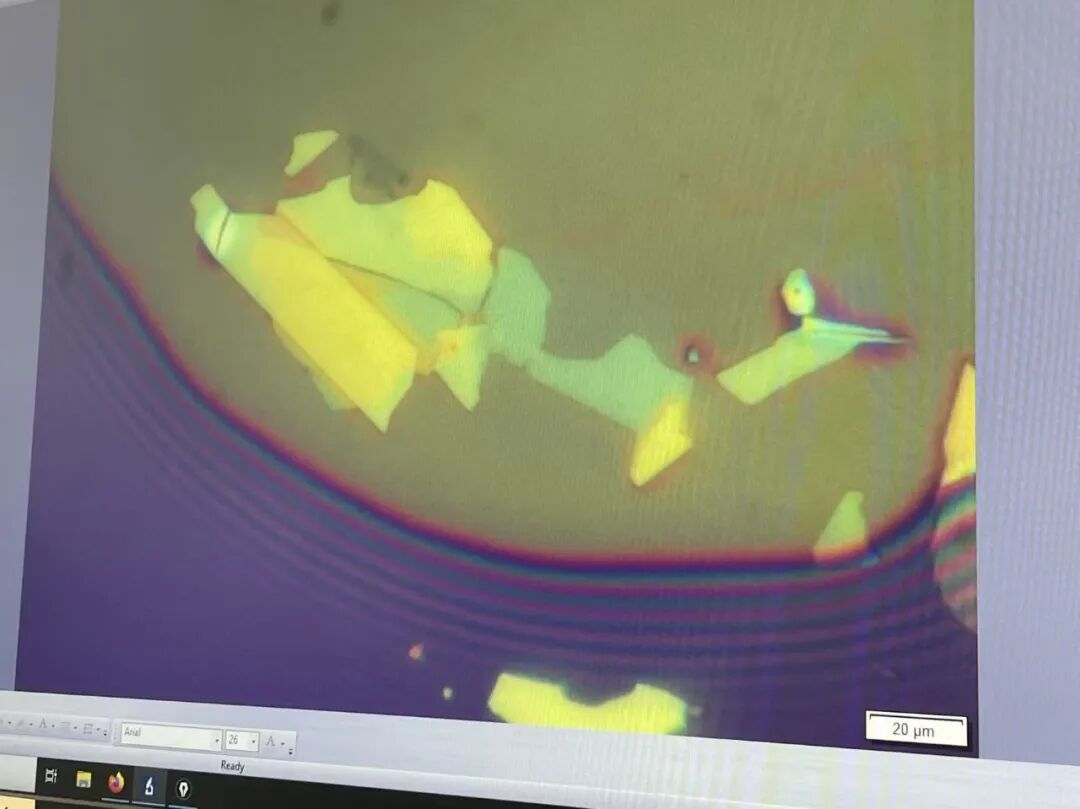
▲ A graphene sample I produced
under a researcher's guidance
Every lab holds something cherished — perhaps a machine as large as an elephant or a sample barely visible under a microscope. One researcher spoke of a machine they had nurtured for years, refining it until it became widely used. Another, nearing retirement, insisted on finding a worthy successor for their work.
Some rushed through lunch to return to their "appointments" with their machines. Others, well past retirement age, still come in daily, determined to solve persistent challenges. I want to thank them for the light in their eyes when they spoke about their work. They are the ones driving the world forward, showing me that people can truly live this way.
This internship opportunity was not easy to come by. I want to thank my parents, the organizer Sage, and the companions who joined me. Above all, I thank UWC for everything it has brought me: by chance, an alumnus from Atlantic College offered us this opportunity at C2N.
It has been an unparalleled experience, made possible by many fortunate coincidences. In just over half a year at UWC, I have met people I never expected to meet and gained opportunities I could never have imagined — courses taught by Nobel laureates, experiments guided by top scientists. UWC is like a vast network, connecting me to the world.
Scientific research is not easy. After experiencing it firsthand, I am more determined than ever to follow my true calling.
-End-