




Two Fingers of Space: Designing for Dignity and Choice
Issue date:2026-09-03
Dr Mark Jiapeng Wang, founder of UWC Changshu China, once said that UWC is committed to nurturing "dreamers who turn ideas into action." Hattie Ruohan Wu, UWC Changshu China Class of 2025, brings this idea to life through her own story.
Four years ago, when Hattie first arrived on campus, she could not have imagined where a Design Technology project would take her. Noticing the challenges faced by older people, she began exploring how design could help. She sketched her first ideas by hand, built prototypes, tested them, and refined the design again and again. Eventually, she developed the classroom project into a finished product, put it into production, and brought it into care facilities for trials, offering care and comfort to older people who wear restraint gloves.
A year ago, after receiving an offer from the Rhode Island School of Design, Hattie chose not to leave for university right away. Instead, she stayed at UWC Changshu China as an intern in the DT department. Over the following year, she supported teaching, deepened her design expertise, and continued developing the project that began in the classroom. She took the idea and care behind the design further, bringing it into real-world care settings.
Now, Hattie shares the story in her own words.
It was a hot summer, with mosquitoes buzzing nonstop. My grandmother poured some mosquito repellent into my palm. As I patted it onto my arms and legs, I heard her say, "Ah, the cap is gone. If we leave it open like this, it'll all evaporate."
"Try a cotton swab!"
"Too thick."
"What about this?"
I held my grandmother's hand and turned the cotton swab around. The bamboo end slid into the bottle opening, while the cotton tip stopped outside and covered it almost perfectly.
Many years have passed, but my grandmother still tells this story from time to time, smiling as she calls me clever. But life is full of messier problems. Most of the time, I only watched and stayed quiet, rarely finding such a quick answer. Whenever something puzzled me, I liked to draw it. Questions and scattered thoughts hid in the lines on paper.
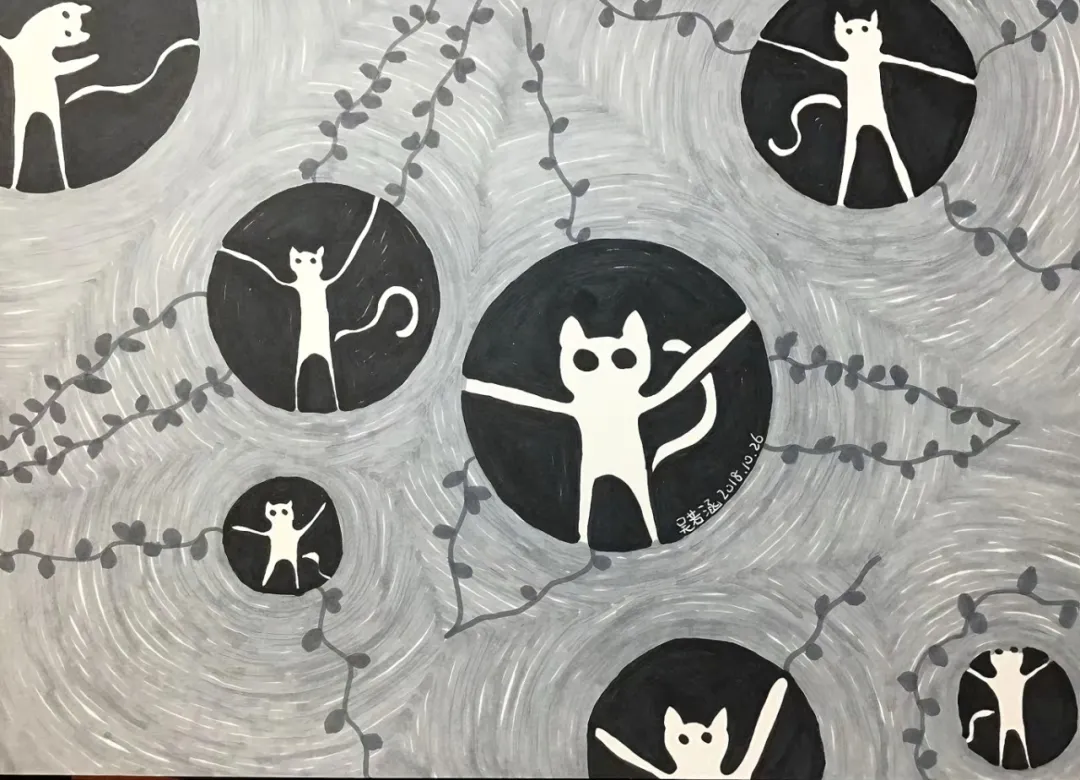
▲ Artwork: False Truth: Through the Eyes, Ears, and Mouth
The image is a black, white, and gray illustration created in 2018. Black circles of different sizes are scattered across the page, each containing a white cat silhouette in a different pose. Gray brushstrokes spread outward like ripples, while dark gray vines weave between the circles and extend beyond the frame. The composition feels connected yet separated.
This drawing held my confusion about the different "truths" people insist on when they argue. There were many other observations like this. But at the time, I had never thought about where these remembered questions could go, other than being covered over by newer thoughts.

At UWC's course selection fair, I first came across Design & Technology (DT).
3D modeling, prototyping, mechanical structures, ergonomics, user research... these were all tools that could appear in a DT classroom. They sounded very cool! But they ultimately pointed toward something the course kept emphasizing: inquiry and problem-solving.
Old and new observations, along with my past drawings, rushed into my mind. Thinking back to False Truth, I wondered: could there be some kind of tool that reduces misunderstandings in an argument, or even helps repair distorted facts? I wanted to use these techniques to respond to problems I had remembered but never known how to solve.
I chose Higher Level without hesitation—in IB, that means more class time and deeper study—and stayed with the course for three years.
The things I had always thought about gradually entered my coursework. When we designed a community space, we began with users' activity preferences and social needs. When we made a mechanical model of an endangered animal, we broke its movements into linkages, gears, and other mechanisms. Again and again, we brought imagination into reality, then used real materials, structures, and user feedback to correct our assumptions.
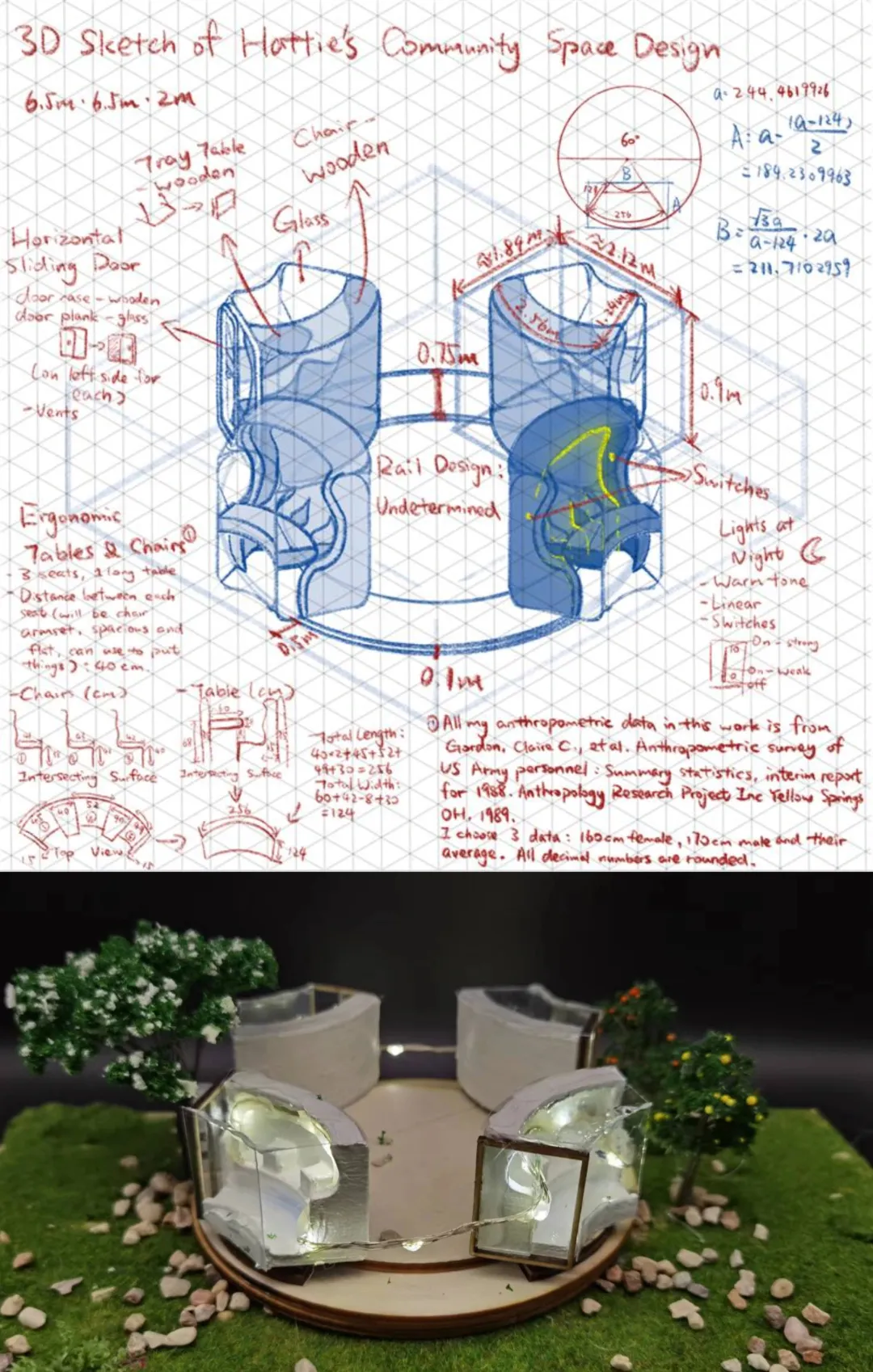
▲ A design sketch on grid paper and the finished model
The sketch shows four curved community spaces around a circular base, with red annotations for dimensions and materials. The model sits on simulated grass, with arched transparent spaces, warm lights, and surrounding trees and gravel.
Like other IB subjects, DT also has an Internal Assessment (IA). Students begin with a real user problem, analyze existing products, develop ideas, build prototypes, test and iterate, and finally judge whether the design truly responds to the original problem. Finding a problem that is both real and worth following for a long time is not easy.
Then, in my second year at UWC, I saw a pair of blue mitts in a care facility.

The large metal gate outside my home collapsed and injured my grandmother. On the night after her joint replacement surgery, I asked for permission to leave school and slept on a small board beside her hospital bed. There were four beds and four elderly patients in the room. The caregiver also set up a bed near the door to watch those who got up at night and prevent falls or wandering.
I am a light sleeper. At night, I often heard murmuring and repeated knocking from nearby beds. In daylight, I saw that Chun and Cao, the two patients next to us, were wearing blue mitts. The broad body of each mitt looked a little like a ping-pong paddle, narrowing tightly at the wrist.
The caregiver told me they were restraint mitts. To prevent accidents or self-harm, and with the family's informed consent, each hand was placed inside a mitt. A wrist strap was tied to the bedrail. A hard insert on the palm side limited grasping, while the strap restricted movement, creating a protective restraint.
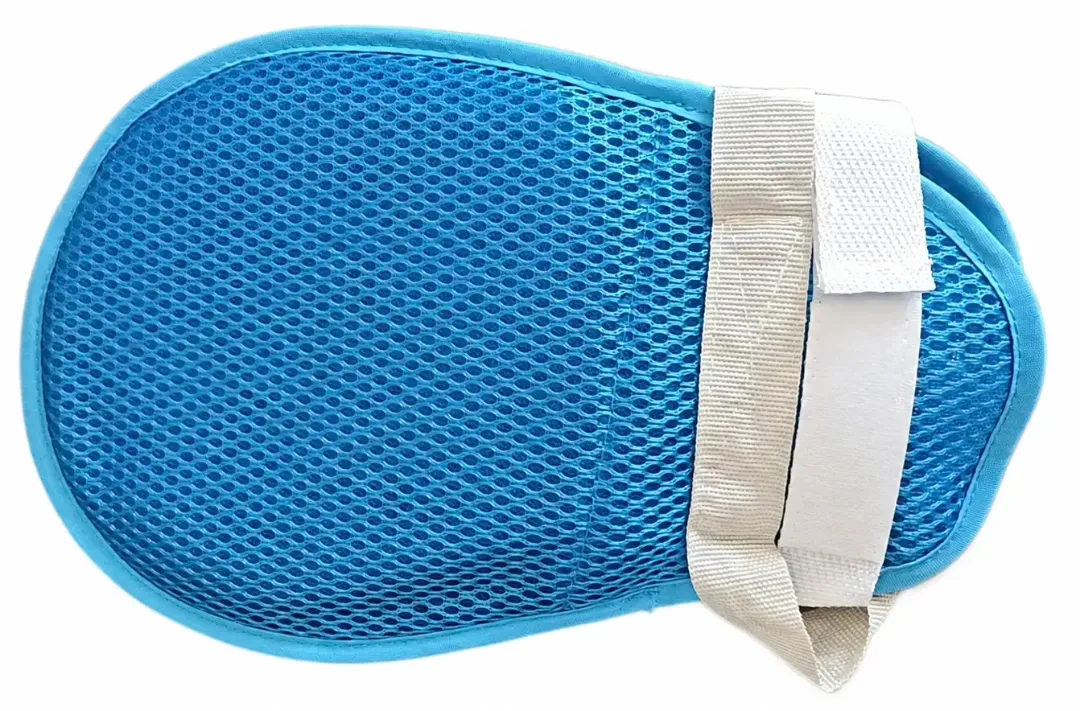
▲ "Blue Mitts": A Common Restraint Mitt Used in Care Settings
The image above shows a commonly sold blue restraint mitt. It has a flat, elongated oval shape, made from opaque blue mesh with light blue edging. At the wrist are two securing straps: one off-white woven strap and one with Velcro for adjusting the fit.
After my grandmother was discharged, I returned to the same room as a companionship volunteer. Cao was still in the bed next to where my grandmother had been. She had been paralyzed from the waist down for more than ten years. Everyone said she was completely confused, and her family rarely visited.
I assisted the caregiver and stayed with her while she ate liquid food. With each spoonful, I encouraged her. She nodded hard, chewed, and always responded. After the meal, I started talking to her. Cao listened carefully, her eyes alert, and her hand movements gradually calmed.
Sometimes she reached up to scratch her face, and the edge of the blue mitt rubbed against her skin. I folded a tissue and dabbed near her cheek.
"Here?"
"You're so kind. You're so kind."
I thought, perhaps she was not as confused as everyone said.
The caregiver taught me how to tie the mitts. "Leave two fingers of space. Not too tight, but she still can't slip out. See?"
When the mitts came off, there were no pressure marks on her wrists. The daily care was careful. But even careful care could not stop Cao from knocking against the bedrail day and night, leaving old and new bruises across the back of her hand.
Protective restraint can reduce the risk of accidents when an older person has cognitive impairment or is not fully conscious, giving families some peace of mind. But it also limits hands that still have feelings and needs.
As I continued researching, one medical accident from 2022 stayed with me. A patient's index finger became trapped in a finger-separating ring inside a restraint mitt. By the time it was noticed, the finger had already become necrotic. The hand had been inside the mitt the whole time, but the opaque mesh kept the change from being seen in time.
I began buying restraint mitts from the market one by one. Most were like two flat pieces sewn together: the hand went inside, then the wrist was secured. But the hands I saw in the care facility were not flat. Because of contracture, many older people's fingers curled inward toward the palm and could no longer fully open. Inside a flat space, such a hand had little room to move or rest comfortably.
Some mitts added padding on the palm side for squeezing and relaxation. But once the padding went in, the already limited two-layer space became even smaller.
Others created more three-dimensional space, but had hard outer shells. They could feel uncomfortable, make noise against the bedrail, or even hurt the user or someone nearby.
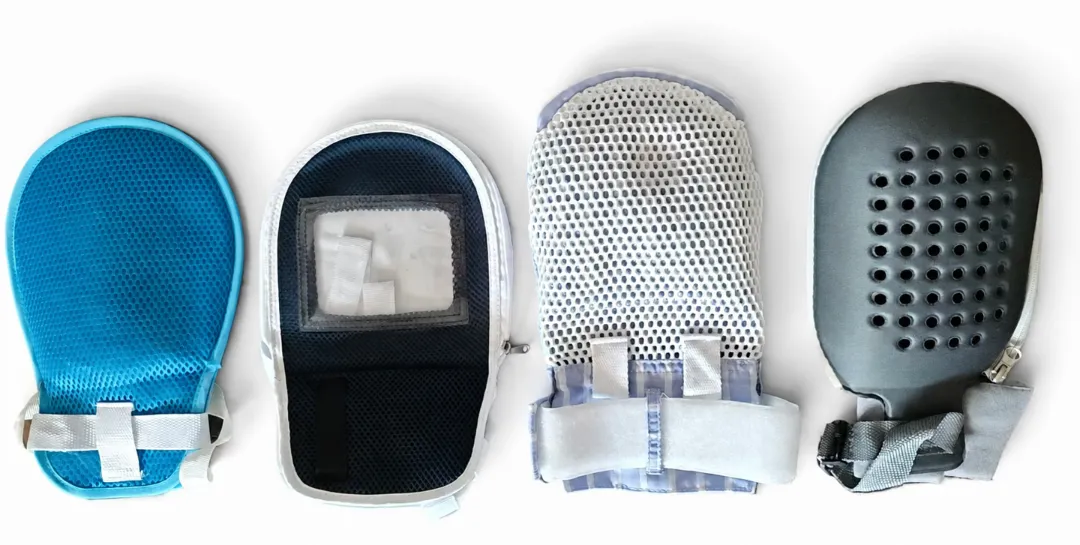
▲Four Restraint Mitts from the Market
In the image, the first three are two-piece flat designs; the fourth has a rigid shell. From left to right: blue mesh with white straps; dark fabric with a clear window and zipper; padded blue-and-white design with wide wrist straps; grey hard-shell with air holes and grey straps.
The two-year DT IA gave me a chance to bring these questions from the care facility back into the classroom. Starting from real users, I could research, design, test, and look for a better answer.
My design was still a restraint mitt. Unlike the products I had found on the market, it had a three-dimensional palm space, allowing a hand curled inward to fit without being forced open. The inside also held removable squeezing modules in different shapes. Different versions could suit different hand shapes and needs, and caregivers could easily remove them for cleaning.
The final functions were simple, but none of the restraint mitts I had seen worked this way.
At that stage, the design still included many bold classroom experiments. Beyond the three-dimensional hand space and removable squeezing modules, I also made hand-massage air cushions and built a wireless system using a small computer. Buttons inside the mitt could connect to different customized needs, allowing people under restraint to access some forms of entertainment.
I kept thinking about how technology should be designed and used to respond to real needs in care.
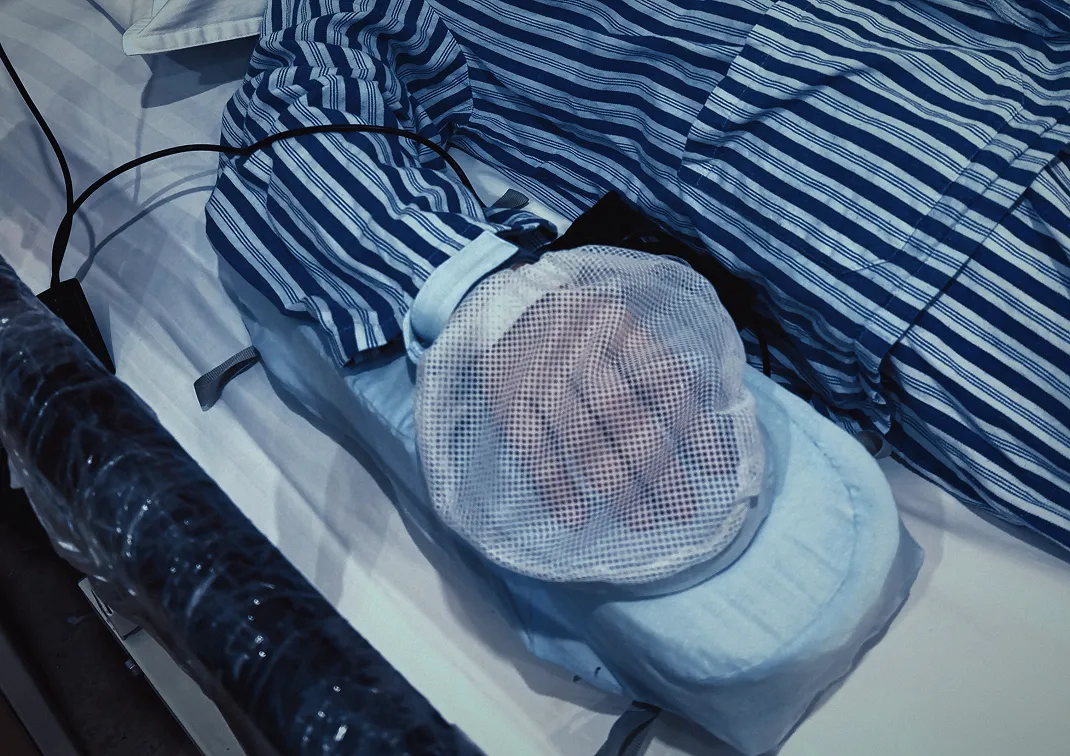
▲Concept Restraint Mitt Prototype Tested by My Grandmother
The image shows an elderly woman lying in a hospital bed, wearing blue-and-white striped hospital clothing. One hand rests inside a light blue restraint mitt prototype. White mesh covers the top, keeping the hand's position visible. The mitt rests on a soft arm-massage cushion, with the bedrail and wires connected to the massage module nearby.

After graduating in 2025, I chose to stay at UWCCSC for a fourth year as an intern in the DT department.
Outside my regular work, I kept thinking about the restraint mitt I had researched for two years. It was still far from something that could truly enter a care setting. What details might be overlooked during long-term use? Would caregivers actually use it? Was my design simply a handmade object made with care, or could it become a mature product that truly solved a problem? A coursework grade could not answer those questions.
Staying as a DT intern gave me a rare stretch of continuous time, while letting me keep using familiar equipment and spaces. During the day, I supported classes, prepared materials, and helped students. Outside work, I kept pushing forward a project that had previously gone only as far as the course required.
To move from coursework to product, I could no longer try everything. I had to focus on what was most necessary.
That year, I applied for a patent, confirmed the medical-device classification, and brought minimum viable prototypes into care facilities. Caregivers turned the mitts over in their hands and told me where they were too large, and where clinical use could be simpler.
One family warmly invited me to eat their home-cooked food and said, "Once you finish it, we'll be the first to switch our old lady over to yours!"
Some feedback was silent. When a squeezing module was placed into an older person's hand, they naturally began squeezing it. One person held onto the soft piece and did not want to let go.
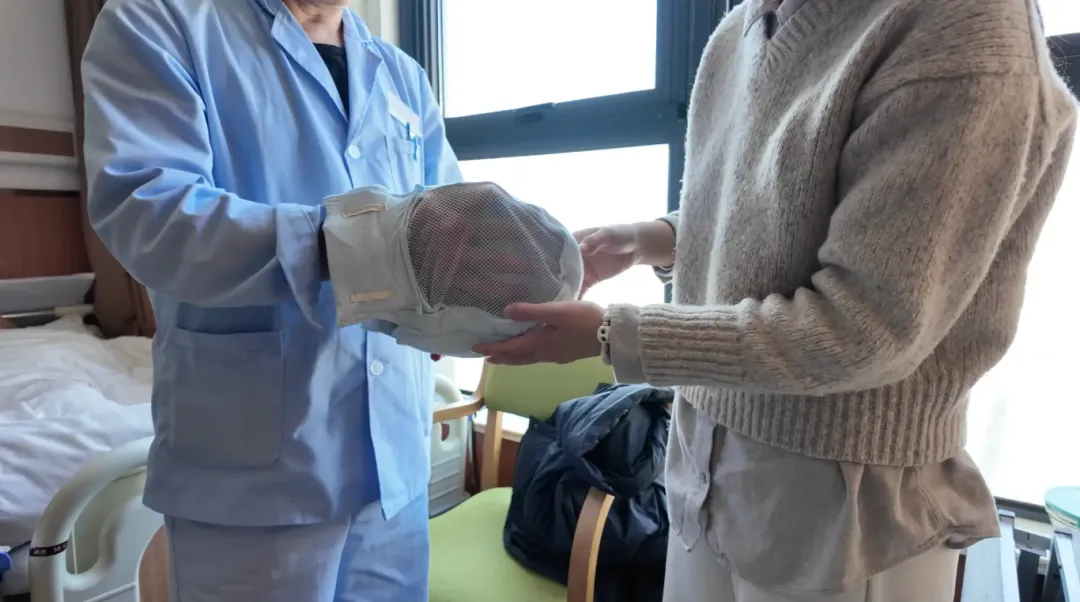
▲Discussing with a Caregiver How the Prototype Could Be Improved
The image shows a room in a care facility. A caregiver in light blue work clothes is trying on a light blue restraint mitt. The author, wearing a beige sweater, stands opposite and talks with him. Together, they turn the mitt over and discuss its size and details that could be improved for clinical use.
Direct feedback and silent responses both entered each iteration. With every visit, the mitt changed from a clumsy hand-sewn object into a third-generation formal sample designed for real care settings.
The most interesting part of the iteration was not adding functions, but removing them.
For example, two years earlier I had explored more complex ergonomic forms for the squeezing modules. In the final version, what remained were simply several soft pieces in different shapes. Their softness and flexible form made them easier to adapt to hands in different conditions.
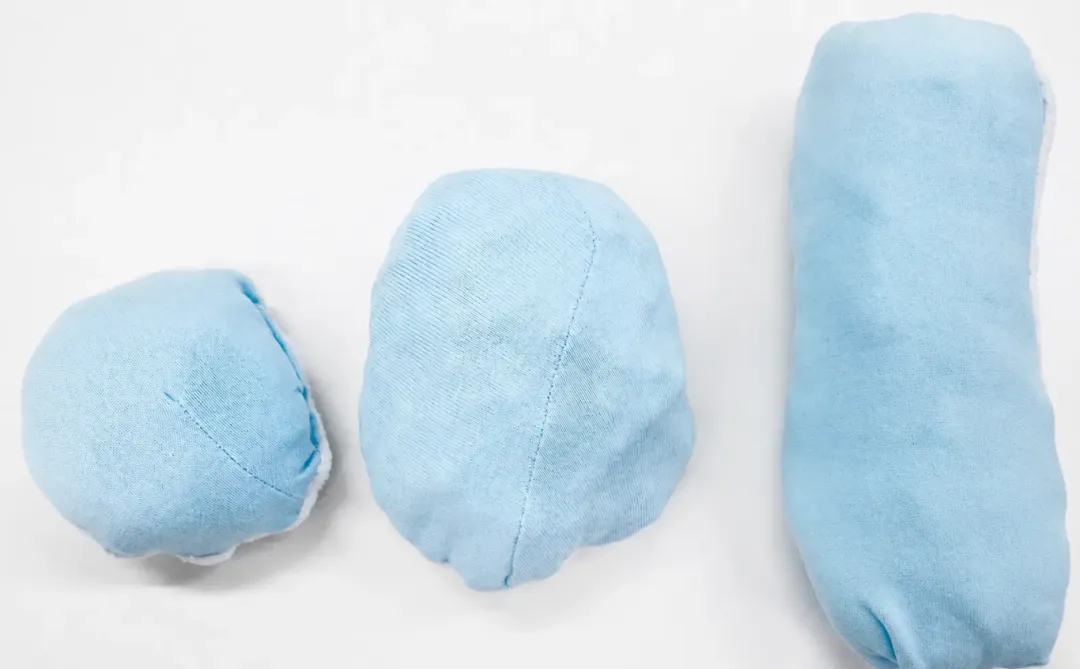
▲Three Rough Prototype Shapes Most Popular in Iteration Testing
The image shows three light blue fabric prototypes sit side by side, shaped like a ball, an oval, and a long cylinder. Visible seams and folds show their rough, handmade testing stage.
The prototypes became more complete, and the positive feedback grew.
"This is really good. It's time to turn it into a real product!"
Hearing that, I became hesitant instead.
Should I keep going?
Over the year, I had moved from apprentice to teaching assistant and was about to take these experiences with me to university. If I kept pushing the design forward, every next step would be unknown. I would no longer have the kind of guidance that came with being a student.
I thought perhaps this was already enough. I could wait until after university and work, when I was better prepared. Then it could break ground naturally.
With the idea of wrapping up this stage, I brought the project to Kuncheng Spark, a UWC program that supports students in moving ideas toward reality.
The process included team formation, ideation, prototyping, and an Expo. Some more developed projects were selected for the final pitch, where students had limited time to explain the problem, solution, and next steps to industry judges and receive feedback. The whole process felt like a small entrepreneurship and design incubator.
The school also invited mentors from universities and technology entrepreneurship.
I brought the restraint mitt to ask for advice, but my thoughts were scattered.
Academic research? Manufacturing? Should I keep going any further?
The more options I saw, the less clear it became what was necessary.
The mentors did not choose for me. They simply explained the different paths: what academic research would require, and what commercialization would involve.
Then they asked me, "What do you want to do?"
Around the time I was selected for the final pitch, I brought the sample back to the care facility. I did not see the family who had once invited me to eat with them.
I asked the caregiver with hope, and learned that she had passed away.
I did not know whether it had happened last week, this week, or even just before I arrived.
Now I could answer the mentors. I wanted to race against time.

On March 31, I gave my final Kuncheng Spark pitch, introducing the project to the judges in five minutes.
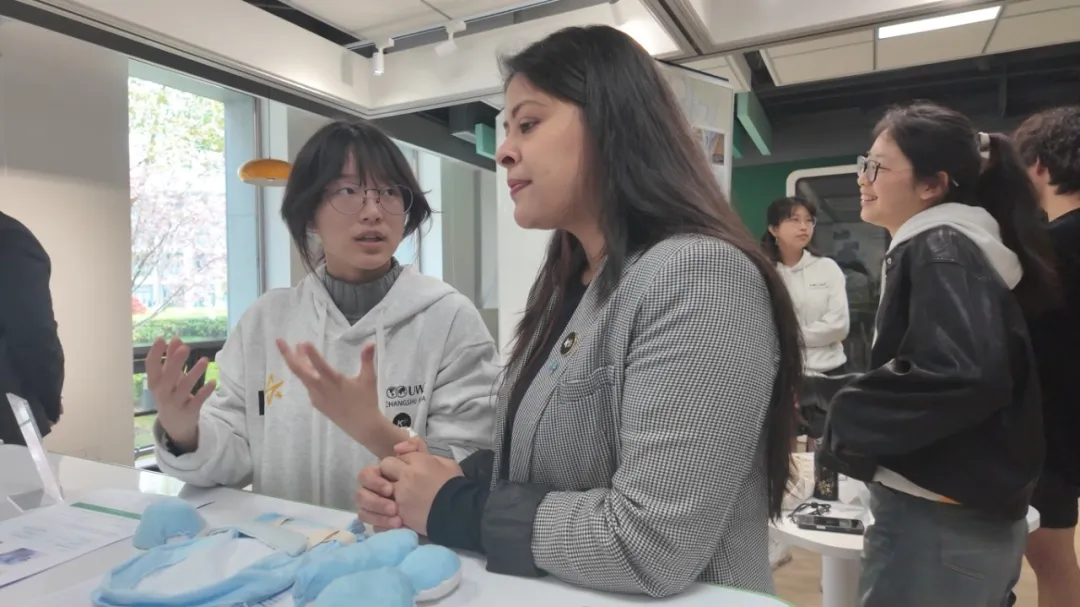
▲Expo Before the Final Kuncheng Spark Pitch
The image shows a bright indoor exhibition space. The author stands beside a display table and gestures with both hands while introducing the light blue restraint mitt prototypes and presentation materials to a visitor. The visitor listens beside her, while other students and guests talk in the background.
Five minutes was only enough to show the tip of a bamboo shoot.
Beneath that small piece of green were deep, tangled roots: shifts in care policy, gaps in the market, and contradictions and opportunities in clinical care.
The judges' feedback gave me a practitioner's lens I hadn't had before. Following those threads, I used the money I had saved from a year of internship work and found a factory in Yangzhou willing to take on a small-batch order. The first run came to 100 pairs of gloves and over 300 squeeze modules.
Before time narrowed my choices, I wanted to get this into people's hands.
By the time you read this, the gloves have already reached some of them: two care facilities are currently testing them, and nine more contacts—including hospice care teams, nursing staff, and friends who believed in the project and offered to share it—will receive theirs soon.
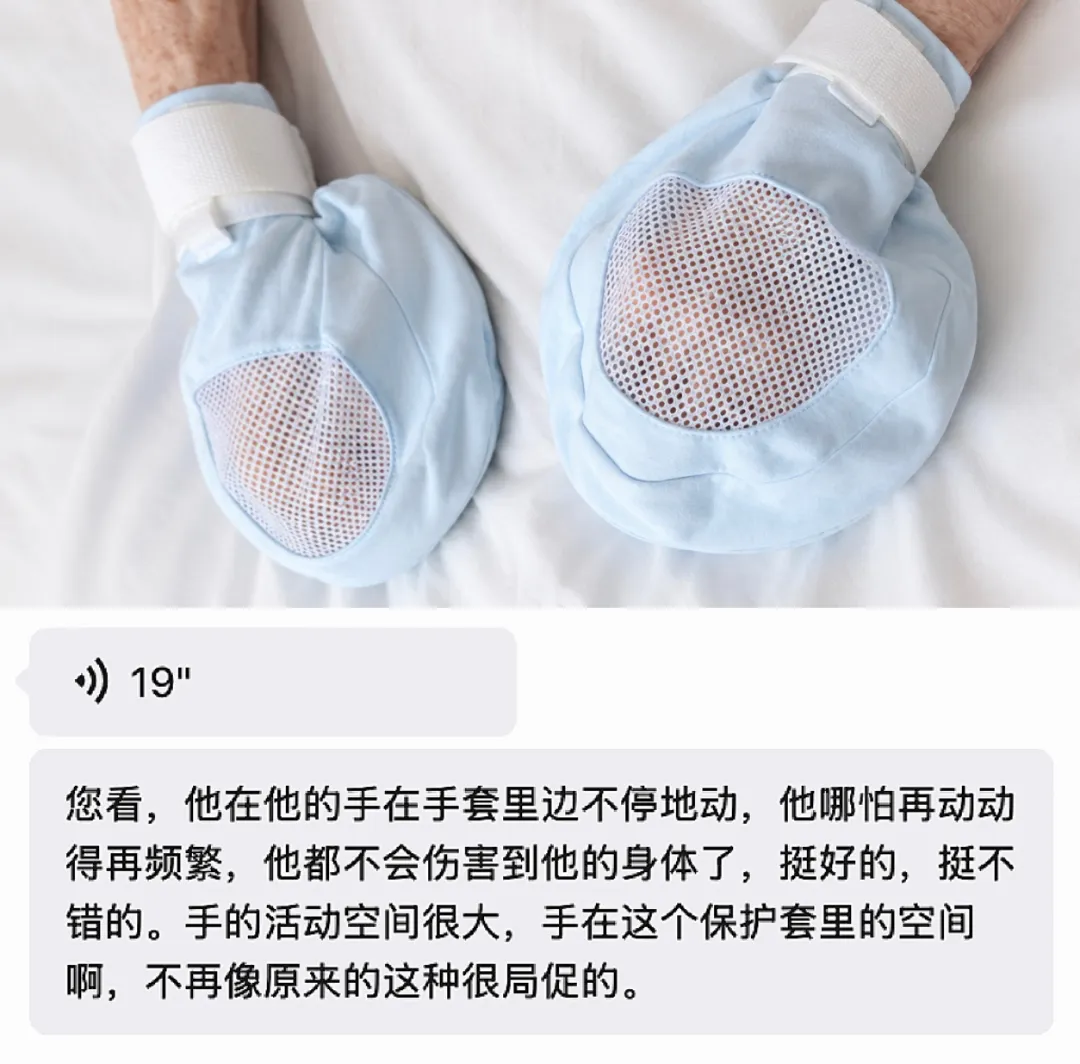
▲ Feedback I Received
Top: an elderly person wearing the light blue mitts, with breathable mesh on the back and roomy white Velcro straps. Bottom: a caregiver's voice feedback, noting the mitt allows free movement while preventing self-harm, and feels less cramped than older designs (private information removed from the image).
I believe this product will not be the answer to end-of-life care. At most, it can be a small companion while care continues to improve. Protective restraint is being reconsidered, and I believe its use will keep decreasing until one day it is no longer needed.
But before that day arrives, there are still people living in blue mitts.
If reality can only leave two fingers of space within restraint for now, I hope my design can at least make that space softer, safer, and more like a choice a human life can still have.

During my internship year at UWC, the restraint mitt project found its way back into the DT classroom in another form.
This year, the IB DT curriculum underwent a comprehensive revision, and the DT department needed new sample materials for the revised 7-point DT IA. My project was selected as one of the samples—used by our school and shared with teachers and students at other IB schools.
While organizing files and writing this article, I found the earliest sketches, the first unevenly sewn prototype, and the changes left by round after round of testing.
The project began in the classroom, then moved into care facilities, pitches, and a factory. Now it has returned to the classroom, becoming material for younger students to understand the design process.
Perhaps breaking ground means allowing something to enter the world and accept being used, understood, and even changed.
What comes after breaking ground?
I keep thinking about elder care, something any of us may experience as we grow old. When aging and disability enter everyday life, familiar things slowly become difficult: holding a phone, walking far, or doing things without depending on others.
So, in a life that becomes more limited, how can we plant a reason to "look forward to tomorrow"?
These questions still have no answers, and there is no rush to find them.
For now, all I can do is carry them into the next room, the next family, and the next hand willing to respond.
-End-
Article and photos by Hattie Ruohan Wu | UWC Changshu China Class of 2025, Rhode Island School of Design Class of 2030.